If you’ve ever tried to recreate the depth and aroma of a great Indian curry at home, you know it’s not just about following a recipe—it’s about understanding the layers behind it. This article is designed to help you master indian curry foundations so you can confidently build rich, balanced, and deeply flavorful dishes in your own kitchen.
Many home cooks struggle with bland gravies, overpowering spices, or textures that just don’t feel authentic. Here, we break down the essential spices, base ingredients, cooking techniques, and timing principles that define truly memorable curries. You’ll learn how to bloom spices properly, develop flavor through sautéing, and create versatile curry bases you can adapt again and again.
Our guidance draws on extensive research into traditional methods, regional variations, and professional kitchen techniques to ensure accuracy and reliability. By the end, you’ll not only follow curry recipes—you’ll understand them, adapt them, and make them your own.
Authentic curry isn’t a single recipe; it’s a system of flavor architecture. Truly transformative. At its heart are indian curry foundations: aromatics, spices, and gravy building. Miss the layering, and dishes taste flat (we’ve all been there).
I won’t pretend every region agrees on exact ratios; even seasoned chefs debate onion browning times. Still, most great curries rely on three pillars:
- Blooming whole and ground spices in fat to unlock volatile oils.
- Building a masala base from slowly cooked onions, ginger, and garlic.
- Balancing heat, acid, and richness at the finish.
Master these principles and intuition follows.
The Heart of Flavor: Mastering Your Masala
To truly appreciate the depth of flavors in Indian curry foundations, one might also explore how these elements come together in some of the best recipes featured in our article, ‘Jalbiteworldfood Best Recipes.’
Masala isn’t just a spice powder you shake from a jar. It’s a concept—a customizable blend of spices that defines a dish. It can be dry, like garam masala, or a wet paste made with ginger, garlic, and chilies. Think of it as the flavor blueprint for many indian curry foundations.
The magic truly happens during bhunao (pronounced bhoo-nao), a technique where spices are roasted or fried in oil to unlock fat-soluble flavor compounds. According to food science research, many aromatic molecules dissolve in fat, not water, which is why tossing spices straight into broth dulls their impact (McGee, On Food and Cooking). To practice bhunao: heat oil, add whole spices until they crackle, stir in aromatics, then ground spices. Cook until the oil slightly separates from the paste (that’s your cue, not a random guess).
Your essential pantry? The big five: cumin seeds, coriander seeds, turmeric powder, red chili powder, and garam masala. Whole spices go in first for tempering; ground spices build body and color later.
Pro tip: Toast whole cumin and coriander before grinding for deeper flavor. (Yes, your kitchen will smell incredible.)
Building the Flavor Base: The Aromatic Trinity
Every great curry begins with three quiet overachievers: onion, ginger, and garlic. Think of them as the rhythm section of a band—rarely flashy, always essential. This trio forms the backbone of many indian curry foundations, setting the stage for every spice that follows.
The Foundation Trio: Why These Three?
- Onion brings sweetness and body.
- Ginger adds warm, peppery brightness.
- Garlic delivers depth and savory punch (that unmistakable aroma that makes people wander into the kitchen).
Skip or rush them, and the curry tastes flat. Build them properly, and even a simple lentil dish feels layered.
The Art of the Onion: Chopped vs. Paste
Here’s where positioning matters.
Finely chopped onions create texture. You’ll see and feel them in the sauce—ideal for rustic curries where structure matters.
Onion paste, on the other hand, melts into the gravy. The result? A smooth, velvety finish perfect for korma or butter-style sauces.
Neither is “better.” It’s texture vs. silkiness. Chunky comfort vs. refined richness.
The Caramelization Spectrum
Onions move through stages, and each one changes the flavor profile:
- Translucent: Mild, slightly sweet, light-bodied.
- Golden brown: Balanced sweetness with nutty undertones.
- Deeply caramelized: Rich, complex, almost jammy depth.
Rushing this step is like pulling cookies from the oven too early (technically edible, emotionally disappointing). Patience transforms sharpness into sweetness.
Incorporating Heat
Add slit green chilies early, right after the onions begin softening. This allows their sharp heat to infuse the oil directly, distributing warmth evenly instead of delivering random spicy surprises.
Pro tip: Salt the onions early—it speeds moisture release and encourages even browning.
Creating the Perfect Gravy: Body, Tang, and Richness
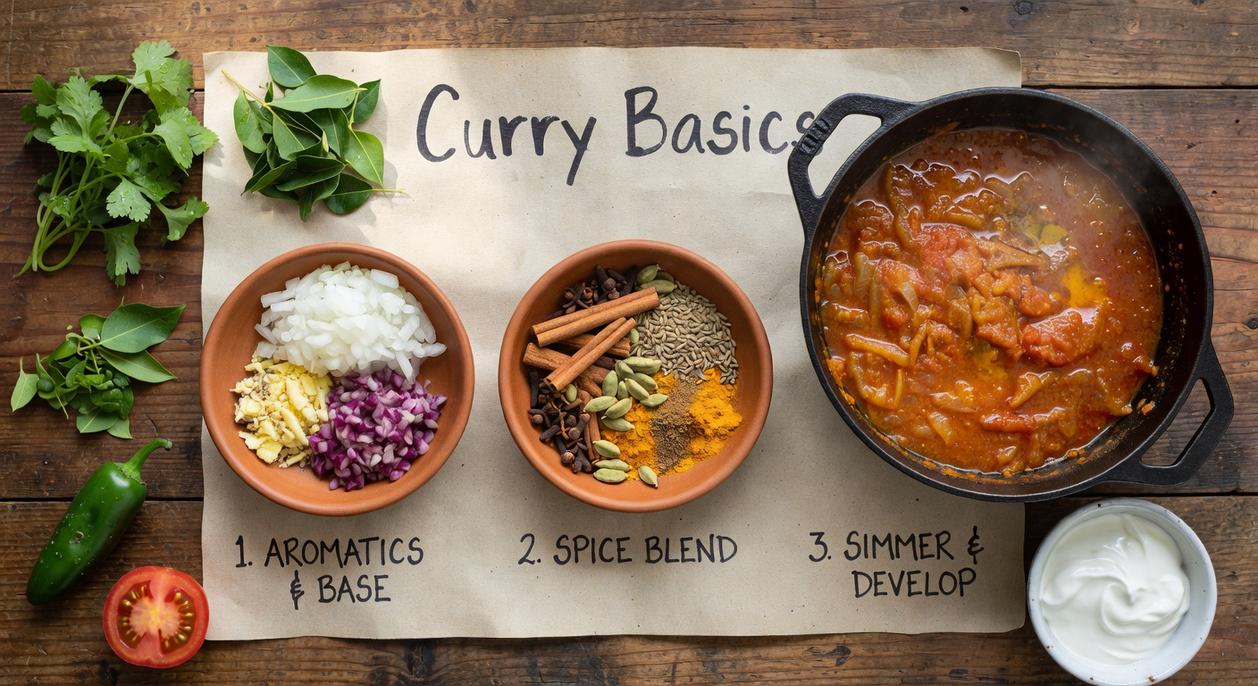
Great gravy isn’t accidental—it’s architecture. And in many indian curry foundations, structure starts with tomatoes.
The Primary Thickener – Tomatoes
Tomatoes bring moisture, acidity (that bright, mouthwatering tang), and a deep red hue. But tossing them in isn’t enough. You need to cook them down until they release their oil—a stage known as tel chhodna (literally, “leaving the oil”). This visual cue tells you the raw taste has mellowed and the flavors have concentrated. Skip this step and your gravy tastes like it’s still thinking about being sauce. Be patient. Let it sizzle and separate. (Good gravy waits for no one—but it does reward the watchful cook.)
The Creamy Agents – Yogurt and Nuts
Yogurt adds tangy richness, but it can split if shocked by heat. Tempering—whisking it with a little warm gravy before adding it back—keeps things smooth. Nut pastes, especially cashew, almond, or melon seed, create that luxurious Mughlai-style body. They emulsify the sauce (bind fat and liquid together) for silkiness worthy of a royal feast. Think butter chicken’s velvet cloak.
The Southern Influence – Coconut
Coconut milk or fresh coconut paste forms the base of many South Indian gravies. The result? A sweet-savory depth that balances spices beautifully. It’s mellow but never boring.
Other Thickeners
Gram flour (besan) adds earthy heft, while onion–poppy seed paste lends subtle thickness in regional dishes.
Master these techniques alongside the essential spices every global kitchen should have, and your gravy will never be thin-skinned again.
The Final Flourish: Finishing for a Professional Touch
To me, the real magic happens at the end. First, tadka—hot ghee shimmering, whole spices crackling, garlic turning golden—gets poured over the curry like a grand finale. That dramatic sizzle? Irresistible (and yes, a little theatrical). Meanwhile, finishing spices matter.
| Finish | Why It Works |
|—|—|
| Garam masala | Preserves delicate aroma |
| Kasuri methi | Adds bittersweet depth |
| Lemon juice | Brightens richness |
I always add garam masala and kasuri methi last; heat dulls them. Finally, fresh cilantro and a squeeze of lemon cut through richness, elevating even solid indian curry foundations beautifully.
Your curry foundation is now built. You understand how flavor stacks, step by step. As one chef told me, “There’s no secret spice—only patience.” In other words, depth comes from technique, not magic.
First, tempering spices—blooming whole spices in hot fat to release fat-soluble aromas (Harold McGee, On Food and Cooking). Then, building an aromatic base of onions, ginger, and garlic. Finally, constructing a gravy that carries everything together.
“So I just follow the recipe?” someone asked. Not quite. Master indian curry foundations and you’ll improvise confidently.
Start small. Brown your onions properly and taste the difference immediately next time.
Mastering Flavor Starts Here
You came here to better understand the building blocks behind unforgettable Indian dishes, and now you have a clear grasp of how spices, aromatics, and technique come together to create depth and balance. By learning the essentials of indian curry foundations, you’ve taken the first step toward cooking with more confidence, creativity, and control.
If you’ve ever felt overwhelmed by bland results, confusing spice blends, or recipes that just don’t taste authentic, that frustration ends here. Mastering these foundations means no more guesswork—just rich, layered flavor every time you step into the kitchen.
Now it’s time to put this knowledge into action. Start experimenting with your own curry base, adjust spices to your taste, and explore new regional variations. For more globally inspired recipes, technique hacks, and flavor guides trusted by thousands of home cooks, explore our latest resources and start cooking smarter today.

 There is a specific skill involved in explaining something clearly — one that is completely separate from actually knowing the subject. Mark Bowensouler has both. They has spent years working with world flavor inspirations in a hands-on capacity, and an equal amount of time figuring out how to translate that experience into writing that people with different backgrounds can actually absorb and use.
Mark tends to approach complex subjects — World Flavor Inspirations, Culinary Pulse, Cooking Technique Hacks being good examples — by starting with what the reader already knows, then building outward from there rather than dropping them in the deep end. It sounds like a small thing. In practice it makes a significant difference in whether someone finishes the article or abandons it halfway through. They is also good at knowing when to stop — a surprisingly underrated skill. Some writers bury useful information under so many caveats and qualifications that the point disappears. Mark knows where the point is and gets there without too many detours.
The practical effect of all this is that people who read Mark's work tend to come away actually capable of doing something with it. Not just vaguely informed — actually capable. For a writer working in world flavor inspirations, that is probably the best possible outcome, and it's the standard Mark holds they's own work to.
There is a specific skill involved in explaining something clearly — one that is completely separate from actually knowing the subject. Mark Bowensouler has both. They has spent years working with world flavor inspirations in a hands-on capacity, and an equal amount of time figuring out how to translate that experience into writing that people with different backgrounds can actually absorb and use.
Mark tends to approach complex subjects — World Flavor Inspirations, Culinary Pulse, Cooking Technique Hacks being good examples — by starting with what the reader already knows, then building outward from there rather than dropping them in the deep end. It sounds like a small thing. In practice it makes a significant difference in whether someone finishes the article or abandons it halfway through. They is also good at knowing when to stop — a surprisingly underrated skill. Some writers bury useful information under so many caveats and qualifications that the point disappears. Mark knows where the point is and gets there without too many detours.
The practical effect of all this is that people who read Mark's work tend to come away actually capable of doing something with it. Not just vaguely informed — actually capable. For a writer working in world flavor inspirations, that is probably the best possible outcome, and it's the standard Mark holds they's own work to.