The Right Tools for the Job: Essential Kitchen Equipment
Just as understanding the essentials of Latin American cooking can elevate your culinary skills, diving into the Mediterranean Pantry Basics for Authentic Flavor can broaden your horizons and enrich your dishes with vibrant tastes from around the globe.
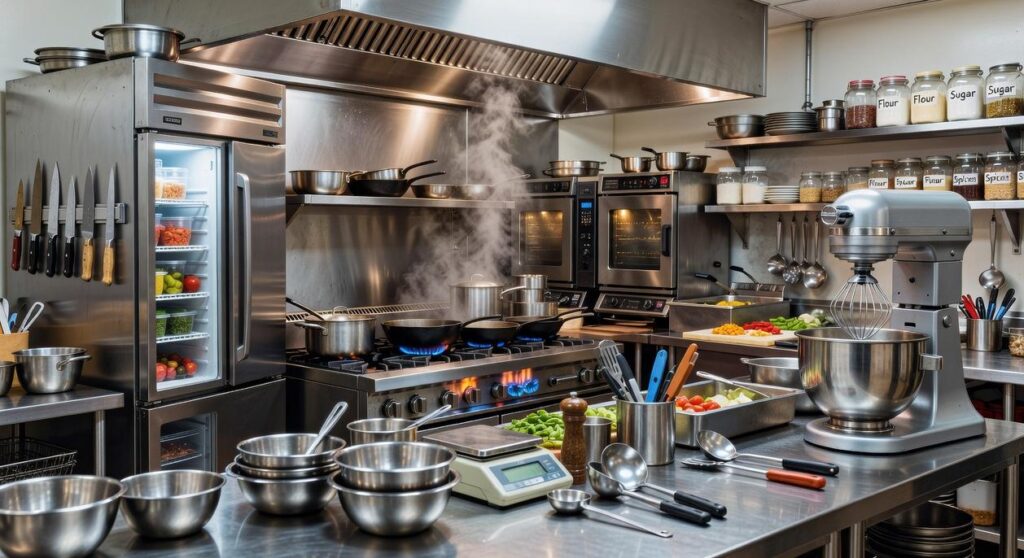
Great cooking isn’t just about ingredients—it’s about choosing the right tool for the task (because yes, the tool really does matter).
For Preparation: Mortar & Pestle vs. Electric Processor
A mortar and pestle—called a molcajete in Mexico or pilón in the Caribbean—is a traditional bowl and club used to crush and grind ingredients by hand. Unlike an electric processor, which chops with spinning blades, a mortar and pestle grinds and presses. That friction releases essential oils from spices and chiles, creating deeper flavor (food scientists note that crushing ruptures more cell walls than slicing alone, enhancing aroma compounds).
An electric processor is faster. But if you want salsa with soul instead of smoothie texture, the molcajete wins.
For Cooking Flatbreads: Comal vs. Standard Pan
A comal is a flat, smooth griddle used for tortillas, toasting dried chiles, and blistering vegetables. Cast iron retains steady heat better than thin nonstick pans, which can create hot spots. In other words, comal equals char; basic pan equals pale (and nobody wants sad tortillas).
For Stews and Rice: Caldero vs. Stockpot
A caldero—a cast aluminum pot similar to a Dutch oven—distributes heat evenly, making it ideal for rice, beans, and braised meats. Stockpots boil; calderos build flavor slowly and evenly.
For Everything Else: Tortilla Press
Finally, a tortilla press flattens dough into uniform rounds in seconds. Hand-rolling works, sure—but if you’re serious about latin american cooking essentials, this tool is a game-changer (pro tip: line it with plastic to prevent sticking).
Your Culinary Journey Begins Now
You came here looking for clarity on latin american cooking essentials—and now you have a practical roadmap. The core flavors, staple ingredients, and must-have tools are no longer a mystery. What once felt overwhelming is now approachable, organized, and within reach.
By stocking a few key items and mastering a couple of foundational techniques, you’ve unlocked the ability to create hundreds of authentic dishes in your own kitchen. That’s the power of starting with the right essentials.
Don’t let inspiration fade. Pick up masa harina, grab a cast-iron skillet, and make your first batch of fresh corn tortillas tonight. Start simple, start now—and bring bold Latin flavors to your table.

 There is a specific skill involved in explaining something clearly — one that is completely separate from actually knowing the subject. Mark Bowensouler has both. They has spent years working with world flavor inspirations in a hands-on capacity, and an equal amount of time figuring out how to translate that experience into writing that people with different backgrounds can actually absorb and use.
Mark tends to approach complex subjects — World Flavor Inspirations, Culinary Pulse, Cooking Technique Hacks being good examples — by starting with what the reader already knows, then building outward from there rather than dropping them in the deep end. It sounds like a small thing. In practice it makes a significant difference in whether someone finishes the article or abandons it halfway through. They is also good at knowing when to stop — a surprisingly underrated skill. Some writers bury useful information under so many caveats and qualifications that the point disappears. Mark knows where the point is and gets there without too many detours.
The practical effect of all this is that people who read Mark's work tend to come away actually capable of doing something with it. Not just vaguely informed — actually capable. For a writer working in world flavor inspirations, that is probably the best possible outcome, and it's the standard Mark holds they's own work to.
There is a specific skill involved in explaining something clearly — one that is completely separate from actually knowing the subject. Mark Bowensouler has both. They has spent years working with world flavor inspirations in a hands-on capacity, and an equal amount of time figuring out how to translate that experience into writing that people with different backgrounds can actually absorb and use.
Mark tends to approach complex subjects — World Flavor Inspirations, Culinary Pulse, Cooking Technique Hacks being good examples — by starting with what the reader already knows, then building outward from there rather than dropping them in the deep end. It sounds like a small thing. In practice it makes a significant difference in whether someone finishes the article or abandons it halfway through. They is also good at knowing when to stop — a surprisingly underrated skill. Some writers bury useful information under so many caveats and qualifications that the point disappears. Mark knows where the point is and gets there without too many detours.
The practical effect of all this is that people who read Mark's work tend to come away actually capable of doing something with it. Not just vaguely informed — actually capable. For a writer working in world flavor inspirations, that is probably the best possible outcome, and it's the standard Mark holds they's own work to.